
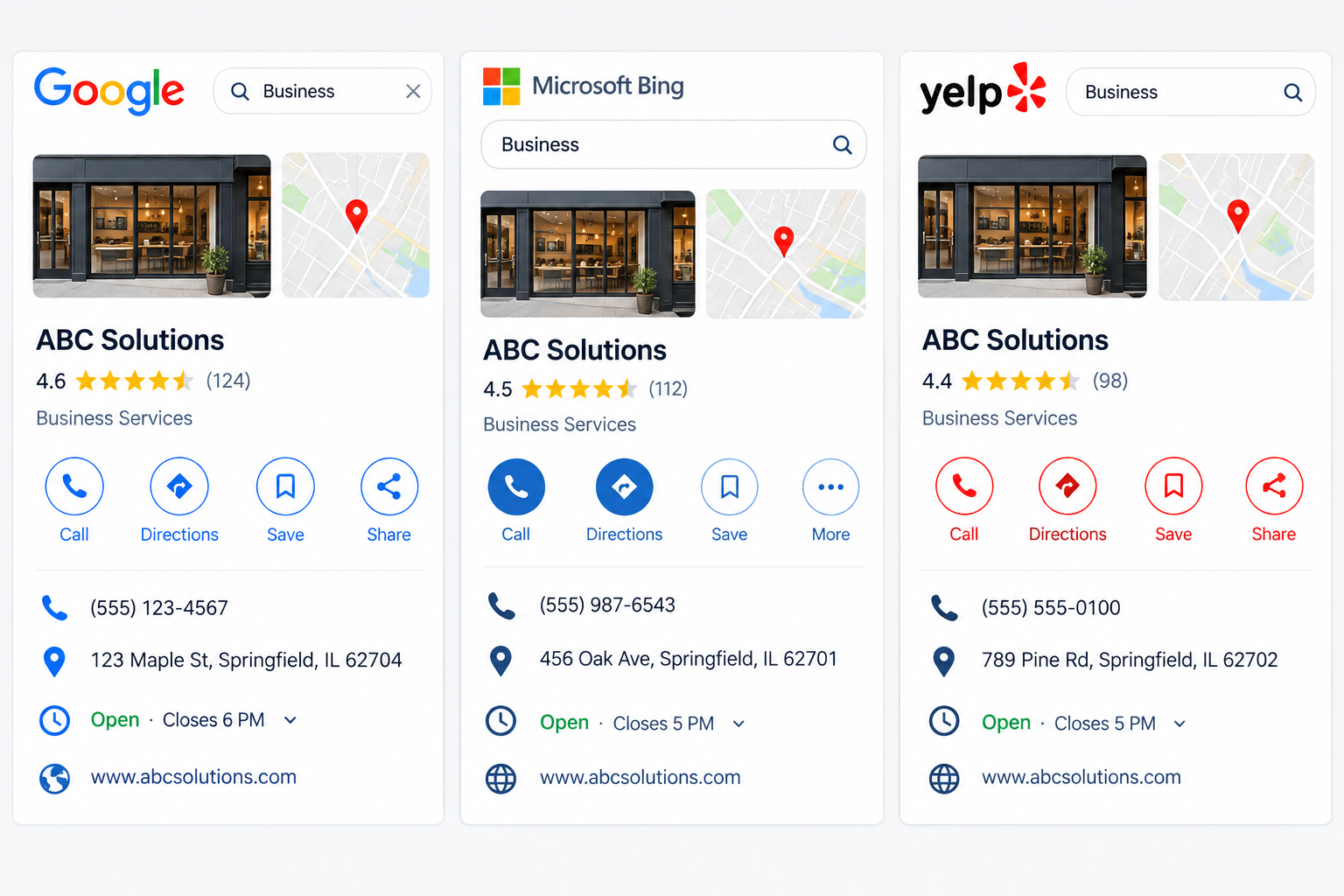
NAP consistency means your business name, address and phone number appear in the same format everywhere online. It matters because both customers and search engines compare your details across the web, and mismatches cost you trust on both sides. In BrightLocal’s Local Citations Trust Report, a survey of 1,025 US consumers, 80% said incorrect or inconsistent contact details would make them lose trust in a local business, and 68% said they’d stop using a business altogether after finding incorrect information in online directories.
The failures are concrete. A customer finds three listings with three slightly different phone numbers and calls the wrong one. Another drives to an old address that still appears on a directory. In the same BrightLocal survey, 36% of consumers said they’d called a wrong number and 22% had visited a wrong location because of bad online information. This guide explains what NAP is, why it matters for local search, how inconsistencies develop and how to audit and correct them.
What Does NAP Stand For?
NAP is short for name, address and phone number, the three details that identify a local business online. Search engines collect them from your website, your Google Business Profile, directories, social platforms, review sites and other sources, then compare them to decide whether the information is reliable.
Many marketers add a fourth element, the website URL, and refer to the group as NAP+W. Hours and business categories also need to be accurate, but name, address and phone number remain the core identifiers.
What Is a Citation?
A citation is any online mention of your NAP details, with or without a link to your website. Examples include a listing in an online directory, a chamber of commerce member page, a local news article or an industry association profile. The more consistent your citations are, the easier it is for search engines to connect them to a single business.
Why Does NAP Consistency Matter?
Google doesn’t publish a formula that says a mismatched phone number lowers your ranking by a set amount. But local SEO professionals broadly agree that consistent business data supports trust, and the logic is easy to follow. Search engines want to show accurate results, and conflicting information makes it harder to be confident about which details are correct.
It Supports Local Search Visibility
Google describes local ranking as depending on relevance, distance and prominence. Prominence reflects how well known a business is across the web, and consistent mentions help search engines recognize that references to your business belong together. When data conflicts, those signals can be split across what look like separate entities.
It Protects the Customer Experience
The practical effects are easier to see than the ranking effects. BrightLocal’s survey found 71% of consumers had a negative experience in the previous year because of incorrect local business information online. Wrong phone numbers lead to missed calls. Old addresses lead to lost visits and negative reviews. Customers rarely blame the directory. They blame the business.
It Reduces Duplicate Listings
Inconsistent details often cause duplicate profiles. If one site lists “Palm Tree Dental, LLC” and another lists “Palm Tree Dentistry,” automated systems may create separate records for the same practice. Duplicates dilute reviews, confuse customers and can be difficult to merge later.
It Helps With Voice and Map Searches
Navigation apps, voice assistants and in-car systems pull data from multiple sources. If those sources disagree, the result may be a wrong route or a call to the wrong number. For businesses that depend on foot traffic or phone calls, this directly affects revenue.
How Do NAP Inconsistencies Happen?
Most mismatches aren’t deliberate. They build up gradually through ordinary business changes and automated data collection.
- Moves and expansions: An old address stays on directories long after a relocation.
- Rebranding: Names change on the website but not on third-party listings.
- Abbreviations: “Street” appears as “St.” on one site and “Street” on another.
- Suite numbers: “Suite 200,” “Ste 200” and “#200” appear in different places.
- Multiple phone numbers: Tracking numbers, mobile numbers and office lines get mixed together.
- Data aggregators: Third-party companies sell and share business data, and errors travel with it.
- Previous owners: Prior listings for the same address or number remain active.
- Staff-created profiles: Employees or vendors create listings without a central record of what was published.
How to Format Your Business Name, Address and Phone Number
The table below summarizes the rules. Details follow.
| Element | Do | Don’t |
|---|---|---|
| Name | Use the official business name exactly as it appears on your signage and invoices. | Don’t add keywords or city names, such as “Best Plumber West Palm Beach.” |
| Address | Choose one address format and use it consistently across all platforms, including the full ZIP code. | Don’t use inconsistent formats such as “Suite 200,” “Ste 200,” and “#200” across different platforms. |
| Phone | Use one primary local phone number and maintain the same format across all platforms. | Don’t use different tracking numbers as the primary contact number on different platforms. |
| Service-Area Business | Hide your address if customers are not served at your business location, and list your service areas instead. | Don’t use a mailbox or virtual office address as a physical storefront. |
Business Name
Use the name customers see on your signage, invoices and website. Google’s guidelines say the name on a Google Business Profile should reflect the real-world name, and adding extra terms can lead to suspension.
Address
Pick one format and follow it. Decide whether to spell out words like Street, Avenue and Boulevard, and whether to write suite numbers as “Suite” or “Ste.” Match the format the United States Postal Service uses if you’re unsure. Include the full ZIP code.
Service-area businesses that don’t serve customers at their location should hide the address on their Google Business Profile and list service areas instead. Make sure other directories follow the same approach where they allow it.
Phone Number
Use a single primary local number. For West Palm Beach, that usually means a 561 area code. Keep the format identical, for example (561) 555-0123, across all listings. If you use call tracking, list the tracking number as a secondary number where the platform allows it, or use dynamic number insertion on your website so your primary listing stays stable.
Where Should Your NAP Appear?
Check each of the following places for accuracy:
- Your website footer, contact page and location pages
- Google Business Profile
- Bing Places and Apple Business Connect
- Facebook, Instagram, LinkedIn and other social profiles
- Industry directories and professional associations
- Review platforms such as Yelp
- Chamber of commerce and local community sites
- Schema markup on your website
- Email signatures, invoices and printed materials
On your website, place the NAP in plain text rather than inside an image, so search engines can read it. Adding LocalBusiness schema markup gives search engines a structured version of the same details.
Step-by-Step NAP Audit
An audit doesn’t need special tools, though they save time. Use this process to find and fix problems.
Step 1: Define the Master Record
Write down the exact name, address, phone number, website, hours and categories you want to use. Treat this as the single source of truth and share it with anyone who manages your listings.
Step 2: Search for Existing Mentions
Search for your business name, your phone number and your address in quotation marks. Include old names, old numbers and previous addresses. Note every site that appears, and record what each one shows.
Step 3: Prioritize Corrections
Start with the sources that carry the most weight. Fix Google Business Profile first, then your own website, then major data aggregators and well-known directories, followed by industry and local sites. Social profiles are worth updating early too, because they’re highly visible. If your Google profile needs broader work, start with our Google Business Profile optimization checklist.
Step 4: Update, Claim and Merge
Claim listings you don’t already control, update the details and request removal of duplicates. Many directories have a process for reporting duplicate or outdated entries. Keep a spreadsheet showing each site, the login used, the date updated and any open requests.
Step 5: Monitor Over Time
Data can change again after you fix it, particularly when aggregators refresh their records. Review your main listings every quarter. Some businesses handle this through ongoing business listings management so updates apply across many platforms at once, but manual checks work well for smaller businesses with a limited number of listings.
Special Situations
Businesses With Multiple Locations
Each location needs its own NAP, its own Google Business Profile and ideally its own page on your website. Don’t use one main number for every location unless that’s how customers actually reach you. Keep a master spreadsheet for each location and apply the same format rules to all of them.
Moving or Rebranding
Treat a move or name change as a project. Update your website and Google Business Profile first, then work through directories. Keep a record of the old name, address and number so you can search for them later and request corrections. Redirect old website pages if the URL structure changes.
Using Call Tracking Numbers
Tracking numbers are useful for measuring marketing, but they shouldn’t replace your main number on core listings. Use them in a limited and documented way so your main number remains the primary identifier.
Home-Based and Virtual Businesses
Don’t use a mailbox, co-working desk or virtual office address as a storefront on Google Business Profile unless the business is staffed there during stated hours. For home-based businesses, hide the address and list a service area instead.
NAP Consistency for West Palm Beach Businesses
West Palm Beach has an active mix of long-term locals, visitors and a large winter wave of seasonal residents, most of them searching from unfamiliar locations on maps and mobile. The area also has businesses that have moved between neighborhoods, merged or changed names, which creates plenty of outdated records. Common local issues include “W Palm Beach” versus “West Palm Beach,” old Okeechobee Boulevard or Clematis Street addresses, and listings that still carry a previous owner’s phone number.
For businesses that depend on foot traffic, accurate data matters most during high season, when the county’s population grows by roughly a tenth and our snowbird season playbook becomes relevant. Businesses that want help reviewing their local presence can look at digital marketing services in West Palm Beach to see what local support involves.
How Does NAP Fit Into a Wider Local SEO Strategy?
NAP consistency is a foundation, not a complete strategy. It supports other work such as page content, reviews, local links and profile optimization. A business with perfect NAP data but thin website content and few reviews will still struggle to rank. A business with strong content but conflicting listings may find its efforts less effective than they should be.
This is why consistent data is usually one of the first items in a search engine optimization plan for a local company. It removes obstacles so other improvements can work properly. If you’re deciding how much to invest in cleanup versus other activities, reviewing service pricing shows how the work is typically structured.
Common NAP Mistakes to Avoid
- Using different business names on different platforms
- Listing a tracking number as the main phone number
- Forgetting to update old directories after a move
- Leaving duplicate listings active
- Placing the address inside an image on the website
- Adding keywords to the business name
- Ignoring suite or unit numbers
- Failing to check data again after the first cleanup
How to Tell Whether the Cleanup Is Working
Results from NAP work are gradual. Look for these signs over several months:
- Fewer wrong-number calls and misdirected visits
- Fewer duplicate listings appearing in searches
- More stable Google Business Profile information
- Gradual improvement in map visibility for relevant searches
- Increases in calls and direction requests in your profile insights
Compare data over three to six months, since changes need time to spread across aggregators and directories.
Frequently Asked Questions
What is NAP consistency in simple terms?
It means your business name, address and phone number are written the same way everywhere they appear online. Consistency helps search engines and customers trust that the details are correct.
Does NAP consistency directly improve rankings?
Google doesn’t assign it a specific ranking weight, but accurate and consistent data is widely considered a trust signal for local search. It also prevents duplicate listings and customer confusion, which affect performance indirectly.
Do small differences like “St.” and “Street” matter?
Usually not, since search engines can interpret common abbreviations. Still, choose one format and use it everywhere to avoid unnecessary variation, especially for suite numbers and business names.
How often should I check my business listings?
Quarterly is a reasonable schedule for most single-location businesses. Check sooner after a move, rebrand, change in phone number or change in ownership.
What should I do about a duplicate listing?
Find the duplicate, then use the platform’s tools to report or merge it. On Google, you can ask for a duplicate to be marked as such. Keep records of each request until it’s resolved.
Can I use a different phone number on each platform?
It’s better not to. Use one primary number everywhere. Tracking numbers can be used in limited ways, but they shouldn’t replace the main number on your core listings.
Who can help me audit my listings?
You can do a basic audit yourself using the steps above. If you prefer to talk through your situation with a specialist, you can contact the team to discuss it.
Final Thoughts
NAP consistency is a simple idea that requires steady attention. Choose a master record, apply it to your website and your main profiles, correct the outdated listings and review them on a schedule. These small habits help customers reach you and give search engines clearer information to work with. For more guides on local visibility, visit Allreact.